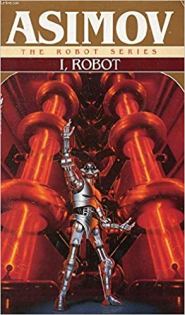
 Still riding the Asimov train, I decided to go back in time and read the book that started it all. Marking the beginning of Asimov’s Robot Series, I, Robot was what kicked off an endless array of books that are now iconic in science fiction. I, Robot is not a single cohesive story, but a collection of stories told by Susan Calvin, chief robopsychologist at the fictional U.S. Robots and Mechanical Men, Inc. The stories are primarily concerned with the aberrant and fascinating behaviour of intelligent robots. Susan’s field, robopsycology, is one that deals with sorting out a robot’s positronic brain, which has gone beyond simple mathematics and programming. Other characters included field engineers Donovan and Powell, who had their own share of inexplicable robot behaviour. This book was also the first appearance of Asimov’s famous three laws of robotics, which play a major role in his Robot Series and has even helped shape the idea of intelligent, ethical robotics in the real world.
The Three Laws of Robotics
1. A robot may not injure a human being or, through inaction, allow a human being to come to harm.
2. A robot must obey orders given it by human beings except where such orders would conflict with the First Law.
3. A robot must protect its own existence as long as such protection does not conflict with the First or Second Law.
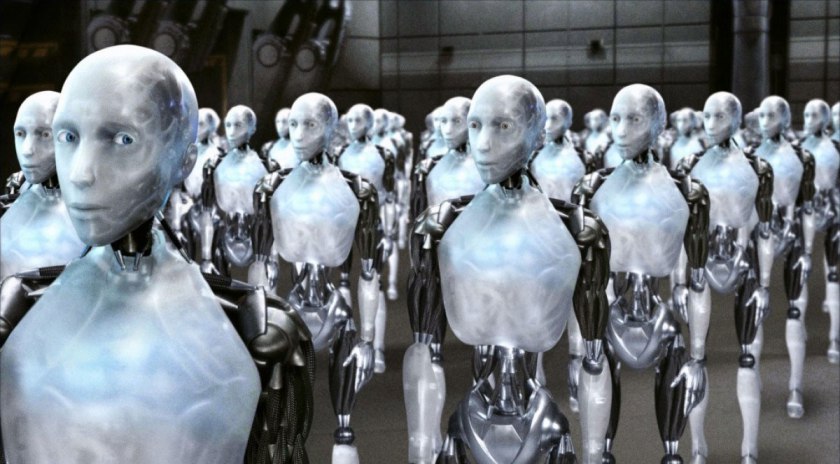
The book was fantastic! The ideas Asimov presented in the book were thought-provoking and the stories thrilling, leaving the reader at the edge of the seat as the humans in the stories tried to outsmart the robots in various situations. Among particular stories, I particularly enjoyed Catch That Rabbit, Liar! and Little Lost Robot. Each had a uniquely different problem thrown at the humans where everyone was confused until the very end when one ingenious idea by one of the characters explains the working of the robot’s brain and reveals why it was behaving like it was. For example, in Catch That Rabbit, we had a primary robot, which was in charge of six subsidiary robots, called his “fingers”. They were assigned the task of mining iron ore under the eyes of Donovan and Powell. However, while the robots were intelligent and capable of independent function, the robot stops producing ore whenever the two humans weren’t there. With nothing seeming wrong with them, it left Donovan and Powell utterly confused why that was. In Little Lost Robot, we have Susan Calvin herself facing the problem of finding a particular robot, who is hiding amongst 63 identical robots with no serial numbers or names to distinguish them. The only difference is the robot has a modified first law of robotics (while it cannot directly harm humans, it is under no obligation to prevent external harm from happening to them), which makes it dangerous. However, since the robot was told to “go lose himself” by a roboticist (a statement said in casual impatience to send the robot away, but taken very literally by the robot), it is actively trying to hide, and the humans are at their wits’ ends trying to find it.
We also encounter other unusual robots, such as Robbie, the compassionate robot, Cutie, the religious robot and Herbie, the mind-reading robot. Many concepts we see in the stories in I, Robot make an appearance in future novels by Asimov. It was amazing to see a book that was written in 1950 still hold up today. In fact, with the technology we have today and the speed at which it is growing, many of Asimov’s dilemmas have become real and are being faced by actual robotics researchers today. That being said, there were a couple stories that left me more confused that fascinated, and were slightly hard to follow. They made it more obvious that this was Asimov’s first book when he was still reaching finding the balance between believable science fiction and something too farfetched. But overall, I consider the book a must-read for science-fiction and literature enjoyers alike. Even readers who don’t connect the book to our world will enjoy it because of the thrilling plot. It is little wonder that it put Asimov on the map and marked the beginning of an amazing scifi adventure.

 Kavi Reads
Leave a comment