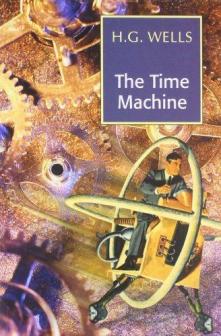
 In Back To The Future (1985), Marty travelled from 1985 to 1955, using the Flux Capacitor. In The Terminator (1984), T-800 travelled from 2029 to 1984 using some Time Displacement Equipment. In Doctor Who (1963-present), The Doctor travels all over space and time in his T.A.R.D.I.S. There are so many fancy names for a vehicle that allows one to travel purposely and selectively forwards or backwards in time currently famous in pop culture. Compared to that, the name H.G. Wells chose almost sounds mundane or unoriginal. But in 1895, The Time Machine was the most original novel there was. In fact, Wells was the first one to the term “time machine” and turn it into a universal phrase to such a vehicle.
The story starts with the narrator, a scientist, along with some colleagues listening to his friend and colleague, an inventor, referred to as the Time Traveller, discuss his theory that time is the fourth dimension. Let me just stop right here. Einstein’s theory of relativity, which popularised the idea of spacetime and proved time is the fourth dimension just like the three in space, came out in 1905. Wells published his book in 1895. Let’s just soak that in. The Time Traveller introduces his colleagues to his new machine which he calls the time machine, using which one can travel back and forth in time. Obviously, everyone scoffs at the Time Traveller and thinks that he is lying, even when he makes a miniature time machine disappear claiming it went to the future. A week later, he walks in looking haggard and in terrible shape. After dinner, he tells his colleagues the tales of his adventures in the year 802,701 A.D.
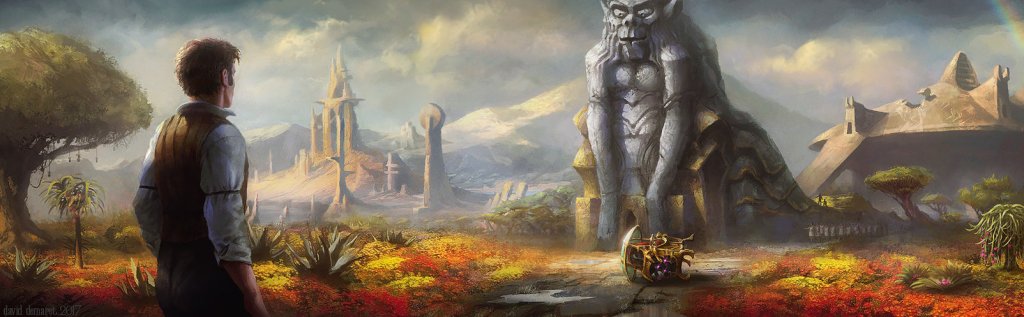
Today, when we think of the future, we always think of the amazing technology that will be available. Advanced robots, flying cars, space colonies, social equality (okay, that one might be asking a bit too much) are thought to be commonplace. But when Wells published The Time Machine, the humans had fairly recently invented lightbulbs (1879), telephones (1876) and the internal combustion engine (1859). Forget modern automation taking over our jobs, Henry Ford hadn’t even come out with his Model T taking over horse-and-cart jobs. So, not surprisingly, Wells’s novel does not feature fascinating technology. Rather, The Time Machine is a social doom prophecy. The privileged, known as the Eloi, have finally gotten a world where they can lead utterly carefree lives of leisure. Unfortunately, the centuries of soft living have turned the rich into weak and stupid creatures. On the other side, the working class, known as the Morlocks, have been forced to live underground in caves. The difference between them has gone far enough that it’s not just about rich and poor. Wells presents us with two different species that have descended from humans. The Eloi are small, elegant, childlike adults afraid of the dark. The Morlocks are ape-like, nocturnal troglodytes afraid of light. In the midst of this, the Time Traveller’s time machine goes missing. He now has the task of not only surviving in this world but also find his only means of escape.
On the surface, it is a fine adventure tale. The story is good and fast-paced, and the descriptions are engaging. And the Time Traveller himself is a fascinating character. Wells manages to keep the reader on edge when the Time Traveller is in danger and curious when he is learning about the new society. I am not going to go too deep criticising the science Wells talks about since one has to remember that the novel was written over a hundred years ago and knowledge was limited at the time. And the fact that a working-class population can exist for long enough to evolve into their own species is also not very believable. We know from human history that the oppressed always rise up against their oppressors. Smalls issues like that aside, even in 2018, I thought the novel has held up very well.



 Kavi Reads
Leave a comment