
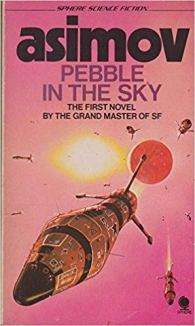
 The book that started it all. The first proper book published by Isaac Asimov, book three in the Galactic series and book seven in the “Greater Foundation” series, Pebble In The Sky is a science fiction classic and a book I was definitely looking forward to reading. Since it was his first book, I was very excited to see how he started; kind of like knowing what the first brick in the Great Wall of China is (that wasn’t mine. I got that line from http://www.sfreviews.net and thought it was pretty clever). And Asimov certainly built a Great Wall, having written or edited more than 500 books. With this book, we get to see Asimov’s initial vision for the Galactic Empire, before his famous Foundation (1951) novel and series, or The Currents of Space (1952), where we see the first stages of the empire and well before Robots and Empire (1985), the prequel to the empire, where the Asimov connects all his books into one universe.
No Spoilers
The story is pure enjoyment. It starts out with quite a bit of excitement, as the retired tailor, Joseph Schwartz is walking around in the streets of Chicago in 1984 when he is suddenly warped into a completely new place, where he recognises nothing and no one. The language is different, the environment looks different and he’s not even sure what planet he’s on. Just like Schwartz, the reader is also left in the dark for a bit, and we don’t know what’s going on. Soon we find out that he travelled in time to thousands of years in the future. Earth is far from the only planet with humans. Humans have conquered the galaxy and together formed an empire, with the planet Trantor at its centre. Earth is nothing more than a “pebble in the sky,” a radioactive dump regarded as a third-world planet in the empire: a common theme in Asimov’s books. And to make things worse, no one knows the origin of humanity and therefore is unaware of Earth’s historical importance.
Right after this initial burst of excitement, the story slows down for a bit, when we get introduced to the characters we would spend time with for the rest of the story. Found by farmers who don’t speak his language, Schwartz is taken to the city of Chica (it took me embarrassingly long to realise that it was a play on Chicago and not China). There he meets Dr Shekt and his daughter Pola and is subject to a device called the Synapsifier, which greatly enhances his mental abilities. He quickly learns the new language and despite already having a photographic memory, is quite surprised at what he was able to accomplish. Beyond learning complex mathematics and mastering chess, he soon discovers he has what he calls the “Mind Touch”.
While this is happening, Bel Arvardan, an archaeologist from a planet in the Sirian sector and a controversial figure in his field arrives on Earth. He is looking for evidence for his theories that Earth was the origin of humanity, a notion that is not widely supported among his peers. Meanwhile, on Earth, the Society of Ancients, an elite group of people equivalent to the Roman Catholic Church in medieval times, are fed up with the resentment that the Outsiders (people from other planets) treat Earth. At various places, Asimov hints that a larger ploy is afoot, that might threaten the entire empire and the trillions of people living under it. By some sheer set of coincidences, misunderstandings and paranoia, the Ancients believe that Schwartz, who has popped up out of nowhere, is an imperial citizen of the empire and along with Arvardan and Shekt, is secretly plotting against them. What follows is an engaging story with perfect amounts of confusion, adventure and mystery. After the initial slowdown in the beginning, the book soon turns into quite a page-turner. The several different parts of the story that slowly unfolded all come together as people realise Schwartz is truly from the past, and that trillions of lives might actually be at risk.
While his later works are a bit more polished, I very much enjoyed reading Pebble in the Sky. Its storyline might be a little too dependent on multiple coincidences to move things along. And there was never a proper explanation for why Schwartz ended up in the future. But Asimov’s world-building and characterisation are obviously top-notch. Even the romance, that people might find rushed, was believable and I did not think was out-of-place. It is quite an impressive debut. And now that I’ve finished this, I can finally move on to Asimov’s crown jewel: the Foundation Series.
Spoilers Ahead
It was quite surprising to see similarities between his first book and one of his later books. Just like Robots and Empire (1985), Pebble In The Sky (1950) also had a mind-reader who realises he can do much more than just read minds. There is also a large plot by madmen in powerful positions to secretly kill a large number of people due to cultural differences. There’s a romance between someone from Earth and one from an outer world, which is considered taboo. Funnily, these similarities are complementary at the same time. The mind-reader is a robot in one, a human in the other. The plot is made by Spacers against Earthmen in one, the other way in the other. The gender roles in the romance are also flipped.
I also loved the ending. It can certainly be considered rushed or a Deus ex Machina. But I thought it was awesome as different authorities were wasting time arguing and accusing each other, while Schwartz just decided to take matters into his own hands and just bomb the temple with the missiles by controlling the mind of a military pilot. And then he just casually came back, let Balkis confess his crime and said he’s taken care of it.


 Kavi Reads
Leave a comment