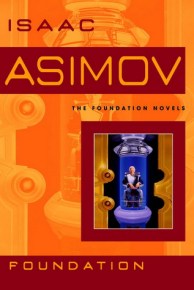
 January, so far, has been a month of re-reads. The first two books (The Adventures of Sherlock Holmes and And Then There Were None) are decades-old classics that I revisited from the mystery genre. And this time I decided to go back to a science fiction gem from the 1950s, but one that still holds up just as good today. Last year, I read eight books by Isaac Asimov and Foundation was the first one before I realised that the Robot and the Empire series precede the Foundation series. After starting from the top with The Caves of Steel and making my way forward, I have finally arrived back where I started.
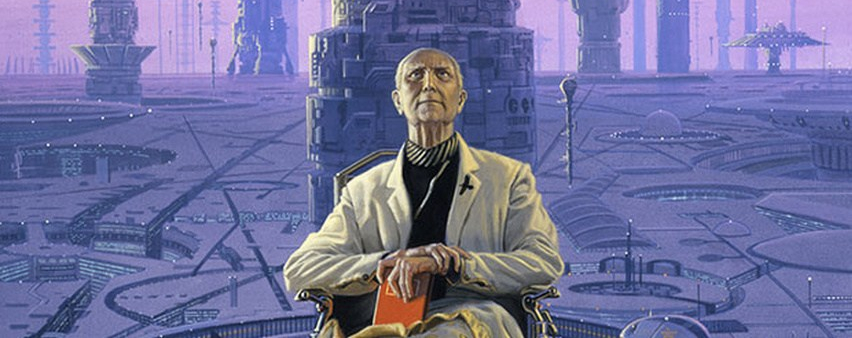
It’s thousands of years in the future. Humans have conquered the galaxy and expanded over millions of planets. No one remembers anymore that Earth was the origin. The capital city of Trantor is home to the Emperor of the Galactic Empire. And that Galactic Empire is falling. Already starting to lose control of planets at the peripheries, it is only a matter of time before the entire human race falls to barbarism that comes when the powerful without anyone to check on them begin feeding on the commoners. The planets not under control of the Empire have already forgotten the science of nuclear power and fallen back to coal and oil. Among all this mess is one beacon of hope: Hari Seldon. Using the science and mathematics of psychohistory, which aims to predict the behaviour of large populations, Seldon predicts there will be a whopping 30,000 years of barbarism that will follow the fall of the Empire. To combat this, he creates an organization: the Foundation and tasks them with cataloguing the entirety of accumulated human knowledge and history in the Encyclopædia Galactica. Sent to a planet without any real resources and surrounded by barbaric, powerful worlds, the question soon arises if Seldon had something bigger planned than just writing a bunch of books.
The book is divided into five parts, each many decades apart, following the journey of the Foundation as they fulfil Seldon’s mission after his death. A journey that is not void of huge challenges, referred to as Seldon crises. A Seldon crisis is a seemingly catastrophic social and political situation that, to overcome, would eventually leave only one possible, inevitable, course of action. While Seldon’s dead hand still guides the Foundation, it is up to them to actually find that course of action. That is what our characters try to do during their times. To confirm that what the characters just faced was indeed a Seldon crisis, Seldon also set up a time vault where a holographic version of him comes at very specific times that Seldon predicted using psychohistory and gives his words of wisdom on how to move forward (this can be before or after a crisis is resolved). Through the first of those, it is revealed that the goal of the Foundation was not to simply write a bunch of books after all. It was to form a base, or a foundation (get it?), of an all-new and more benevolent Second Empire.
Foundation isn’t exactly a science fiction. While, of course, there is interstellar travel, an Empire spanning the entire galaxy, weapons such as blasters, force fields and other wild tech, most of those are in the background. The primary content of the book is the social and political situations that were put in front of our characters. Through three compelling characters — Seldon; the Foundation’s mayor Salvor Hardin; the merchant prince Hober Mallow — the story of the Foundation’s rise is told with surprisingly little overt action, but loads of incredibly entertaining political savvy. From the Foundation’s formation to its struggle to maintain balance with the powerful worlds around it, to its rise to dominance based on religion and later trade, Asimov takes us on a wondrous journey. With Asimov, we get a developed and mature version of SF; one that still holds up almost 70 years after it was published.
Questions Foundation raised in my mind
- With the age of data going on right now and with the advent of the internet (which didn’t exist in Asimov’s time), if humans were to conquer the galaxy, would people really forget Earth and our history/origin?
- Religion is a strong pillar that the Foundation stands on. It’s what solved the second Seldon crisis. People on other planets worship the Foundation. Is that realistic?
- Seldon’s psychohistory-based predictions are based on large masses, billions even. But the crises are solved by individuals like Hardin and Mallow. So, how big of a role did they really play? If they didn’t do anything, would the crises be solved anyway?
- Where are all the robots? Asimov clearly had them in mind with the Robot series.
- And aliens? Shouldn’t some planet have some?


 Kavi Reads
Leave a comment