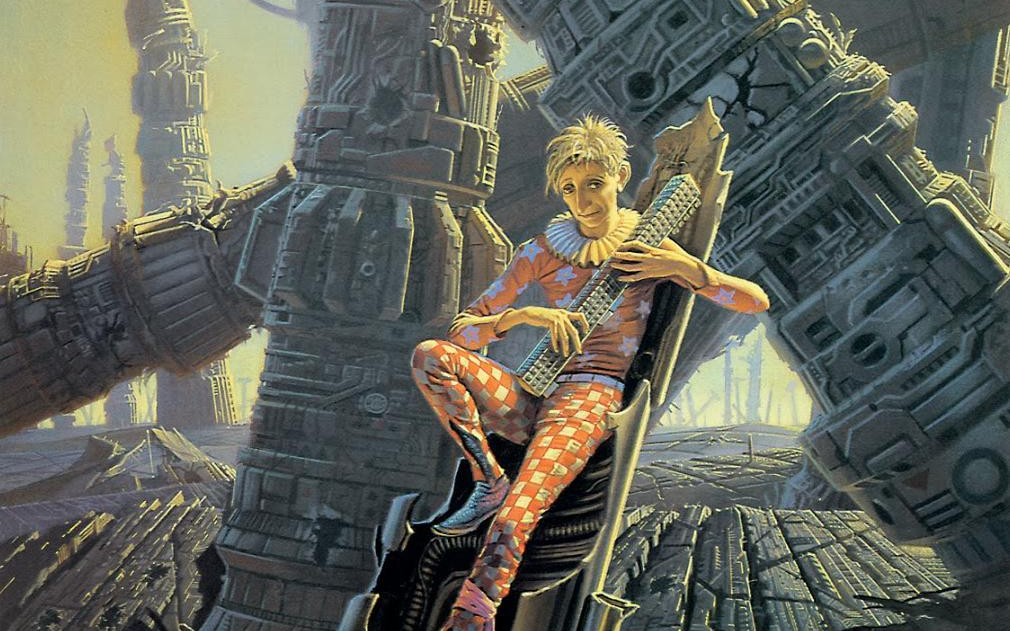
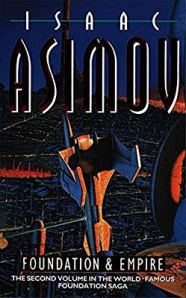
 The second entry in Asimov’s famous Foundation series and a more dramatic and darker sequel to Isaac Asimov’s famous Foundation, Foundation and Empire takes us past the initial stages of the Foundation. This is where things get more dramatic and more interesting. There’s a much faster pace here with deception, double-crossing and treachery throughout. First published 1952, by an Asimov in his 20s, the book has an astonishingly wide range and vision in terms of what good, clean science fiction is. Though it is void of any mega intergalactic wars (the only real battles are simply mentioned and not fully played out), it is much less talky than Foundation, with a higher level of thrill and excitement.
First, some back story. The Galactic Empire is dying. It has been on a downward trajectory for centuries. What will follow is thousands of years of chaos and barbarism, until humanity once again unites under a second empire. One man saw it coming: Hari Seldon. Through the mathematics of psychohistory, he predicted how the future will play out if left untouched. To combat this, and reduce the grace period between the empire to just a few hundred years, he created the Foundation, a group of scientists on the edge of the galaxy. As it goes with large organisations, the leaders are getting comfortable in their spots. To quote one of the Traders, “Every vice of the Empire has been repeated in the Foundation. Inertia! Our ruling class knows one law: no change.” Revolutionary men like Salvor Hardin and Hober Mallow are just great names in history, there to be praised but not followed. Backed by Seldon’s mathematical certainty of their success, they have let go of any worries. Until The Mule takes over.
Note: possible spoilers ahead, but they’re easy to see coming and shouldn’t take anything away from the reading experience
The first challenge they face is the dying empire. Hearing that at the edge of the galaxy, a group of planets is planning to form the base of a second empire, the current emperor immediately takes action and sends his most talented general and his second in command to deal with the situation. And though a Foundation trader and an old veteran try to take matters into their own hands, in the end, the Seldon forces prevail and the war ends in the Foundation’s favour despite the Empire having the upper hand. In fact, the covert governing body of the Foundation doesn’t even bother to intervene, realising that the collapse of the Empire would happen, with or without their guidance. And once again, Seldon’s dead hand prevails making the leadership of the Foundation even more comfortable.
But those leaders forgot a critical thing. Seldon’s predictions are nothing more than probabilities. He can nudge things in ways to help out the Foundation, whether it is things he did before his death or the words of wisdom he gives from his holographic projections in the Time Vault, but in the end, all he can do is make the probability of success go from 94% to, say, 98%. There still remains that 2% chance of failure. Hari Seldon’s brilliant predictions only work for large crowds; billions of humans forming powerful social and political forces. Individuals can neither be predicted nor do they matter in psychohistory. That is until they do. When a mutant, who goes by “The Mule”, with abnormal powers and unlimited ambitions effortlessly comes to power and starts to undo the careful planning done by Seldon, is there any way to stop him?
The helplessness of the Foundation against the Mule dawns on them when Seldon’s hologram comes out of the time vault to discuss the ongoing Seldon crisis, but to their shock and dismay, starts talking about a completely different crisis. They realise Seldon’s predictions were, for the first time in the history of the Foundation, wrong. It doesn’t take long for The Mule to take over. With his mind control powers, there seems no way to stop him. Even if he is stopped, who will rebuild the Foundation now that Seldon’s predictions have been deemed invalid and obsolete with the advent of the Mule?
Spoilers Ahead
This is the third time in Asimov’s universe that we meet someone with mind-controlling abilities, after Giskard in The Robots of Dawn and Schwartz in Pebble In The Sky. It is fascinating that Asimov keeps going back to this. It stands out because out of all the “fiction” in Asimov’s science fiction books, this is the only unrealistic one (at least for now). It was also interesting that all three characters got their powers in very different ways but never intentionally. Giskard was a robot, who’s brain was manipulated in a way to allow telepathy. Schwartz was part of an experiment to improve his mental abilities that went wrong. And The Mule was just born with the powers (at least that’s what we know for now). What amazes me the most is how similar these scenarios are to what we have in pop culture today. Experiments going wrong and being born with powers are the reason behind over half the superheroes in current Marvel movies. Yet, Asimov told these stories decades ago.


 Kavi Reads
Leave a comment