
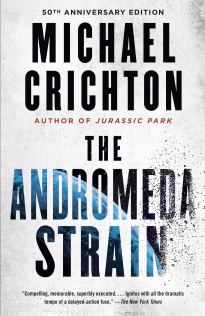
 It’s a great feeling when you finish a book in two days. Very few books can maintain the thrill so consistently for me and Michael Crichton’s The Andromeda Strain hit all the right spots. A science-fiction thriller that successfully combines space, biology and peril, the book was published in 1969, just a couple months before the Moon Landing, and I imagine if the astronauts read this before launching off, they might have been a little hesitant to do so. The book is about the efforts of a team of scientists investigating the outbreak of a deadly extraterrestrial microorganism that can kill within seconds of exposure.
No Spoilers
The plot starts out with an aura of mystery around it with two officers slowly approaching a small town showing no sign of life trying to recover a military satellite which has returned to Earth. As they get closer, they start seeing corpses all around town and just as they see a man in white robes walking among them, radio contact with them ceases, ending with their screams. Immediately, the reader gets a sense of apprehension, a feeling that never leaves throughout the rest of the book.
Next, we are introduced to the government protocol to combat this kind of threat called Wildfire. Two members of the Wildfire team investigate the town, this time with proper protection so as to not get infected. They soon discover that not all residents of the town died instantly. Some committed suicide in bizarre ways as if a cloud of insanity hit the town. And that is not all. Two survived, an old man and a newborn baby. Once the team has enough evidence to continue with their investigation, it is decided that it is best to nuke the town to prevent further spread.
We spend the rest of the book in the Wildfire facility, a heavily-secured, underground area with high-tech instruments that allow scientists to study the microorganism that seems to have decimated a whole town without getting exposed to it directly. This is where I think Crichton shined. While the book was written in 1969, the futuristic technology described is completely realistic. From the underground laboratory, the computer programs, the biometrics security, at no point did any of it seem too farfetched. The book feels like it could have easily been written in the 21st century.
To add to the suspense, the book is written almost as a document written after the events, sprinkled with sentences such as “a decision he later regretted” or “neither the machine nor the man was able to catch the error”. Crichton was not afraid to tell us when and where the scientists might be making a mistake, but we were never told what was wrong and how it affected them until they realised it themselves. This made the book all the more engrossing. This suspense was most highly accentuated when it is revealed to the reader early on that the town was never nuked and the microorganism is still out there, something even the scientists didn’t know until much later.
Overall, the book was outstanding. I was glued to it until the end. Even when not reading, I was constantly thinking about what might happen next. More than that, it has got me wondering now if this can actually happen, and if we would really be able to keep such an infection from spreading for long enough to find a cure.
Spoilers ahead
I had almost forgotten that the town was never nuked, a decision the President of the US made against the recommendations of the scientists. It wasn’t until one the scientists of the Wildfire team said “and with Piedmont nuked” that I realised that they didn’t know. I was under the impression that the scientists were on a time crunch the whole time, especially as they were working for 15-20 hours a day. But it wasn’t until we were closer to the end that things really got tense for them. Of course, I could never have seen it coming that the President’s decision to not nuke the town was the right one in the end, but that’s just my bias towards scientists over politicians.
I will admit, I was a little disappointed by the ending. With all the suspense and thrill the book maintained, the ending felt a bit too easy. That the microorganism simply mutated to not be deadly anymore on its own was an unexpected turn, especially as it started eating through the plastics used to secure the labs. However, the scientists would just take this as a victory and assume it won’t ever be harmful again seemed unrealistic. I feel like Crichton could have made this book twice as long and gone through some events in more detail and ended with an actual solution found by the scientists. But given my only real criticism is that the book was too short, I will still stand by the fact that the book was outstanding.

 Kavi Reads
Leave a comment