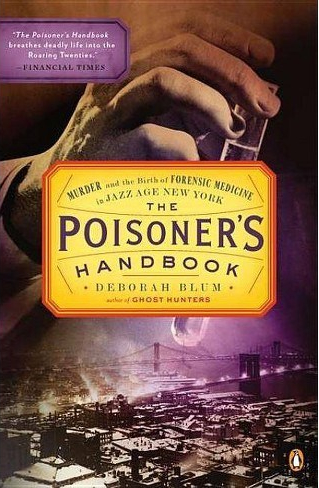
 I once found myself with a Barnes & Noble gift card and decided to hunt for a book in the store. There were so many options in all the genres, and as I was browsing through, narrowing it down, something about the title The Poisoner’s Handbook attracted me. It was most likely the subtitle, ‘Murder and the Birth of Forensic Medicine in Jazz Age New York‘ And I decided to go for it. The table of contents had a neat list of toxins like cyanide, arsenic, carbon monoxide, and many more. I always enjoyed chemistry in high school and college and figured it might be fun to read about various poisons, how they affect the body and how they are detected. Later, a pen pal asked me how it was, as she was considering it for her book club. I decided to quickly read it before replying.
I imagined this to be a technical book where we go one poison after another. It turned out to be so much more. Deborah Blum turned what could’ve been a boring, technical topic into a thrilling and compelling story about the growth of forensic science. While it is fascinating how a few drops on a particular chemical can completely stop our incredibly complex bodies from functioning, the details of the toxins and various murders were just her means for telling that story. The true stars of her book are the pioneers who brought forensic science to life and made it a crucial, and unquestionable part of criminal investigations.
At the centre of the stage was a man named Charles Norris. Tired of seeing the medical examiner’s office full of unqualified, corrupt political appointees, Norris stepped in as the first Chief Medical Examiner of the City of New York who actually qualified for it. Along with him was his right hand, forensic chemist Alexander Gettler. Together, they would change the world around them and birth the true science of forensics that we see glorified in TV shows like CSI today.
The book is everything you would expect not from a pop-sci book, but from a detective novel. Blum wrote a fast-paced page-turner, full of action and intrigue, and as an added bonus, with tons of real science in it. In fact, it is a detective novel. Each chapter focuses on a particular poison, along with one or more homicide cases where the police were lost. In came the duo, like Holmes and Watson, to solve the mystery. But who needs fictional detectives when you have the real deal? Norris and Gettler were exactly that. They affected rules and legislation with their work, sent clever murderers to the electric chair and exonerated the innocents who were headed that way due to mistakes of the non-science-based courtroom battles. All that came through long, gruesome hours of tedious work, trying to detect the smallest quantities of the poison and studying their effects on animals, people, tissues. It was incredible, inspirational even, to read.
Along with toxicology, the book has various political and social themes as well. While some poisons were widely known for their toxic nature, others were a mystery at first. In fact, a lot of them were used in normal, everyday products. From the cyanide gas used for fumigation to watch dials painted with radium, it was as if you never knew what would turn out to be a killer. And just like Big Tobacco fought furiously against smoking laws, any company whose products were suddenly found to be dangerous stood against the scientists. Also heavily featured in the book is the Prohibition era of the US along with the politics and social ramifications that it caused, including the deaths due to the often deadly, bootlegged alcohol.
Overall, this is an excellent example of a popular science book. It has all the right elements, perfectly balanced between thrilling crime-solving tales and detailed chemical explanations and lab procedures, that kept me glued until the end. It left me wanting to learn more, especially given how far we have come since the time of Norris and Gettler. And in the end, it made me appreciate the value of simple, hard work through which two people did wonders in their field.


 Kavi Reads
Leave a comment