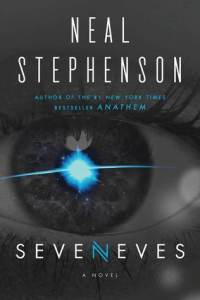
 I don’t usually read science fiction. This may come as a surprise to people who know me, given my interests in astronomy. There was always something about stories involving things like time travel or moving faster than light that didn’t attract me. Part of it was because they seemed like cop-out methods to get the heroes out of trouble. Moreover, there were enough books with real science in them that fascinated me. Seveneves was different. It belongs to a sub-genre of science fiction that I’m becoming a fan of known as hard science fiction. It is a category of science fiction that focuses on scientific accuracy. And there may be technologies and gadgets that don’t exist in the real world yet (and there certainly were in Seveneves), they are possible within the next few decades.
I had first heard of Seveneves when it was recommended by Bill Gates on his blog, and I just couldn’t ignore the man. Of course, unlike Gates, I wasn’t able to go meet the author and take a selfie with him before I started reading the book. It took me a while to actually get to the book though; the 800-page length scared me and I was on a time crunch last year to finish a book a week.
The plot of Seveneves gets going when the moon blows up into seven pieces without any warning or apparent reason. And this is not a spoiler. It happens in the first two pages. It was as if the centre of the moon had a time bomb and it somehow got triggered. The people, scientists included, were fascinated, and regular observing parties started taking place. All was merry until two of the seven pieces collided and one of the two broke into two more pieces to give a total of eight. When this happened, a famous scientist and science communicator (a Neil deGrasse Tyson/Bill Nye-equivalent) reached a horrific conclusion: the collisions are going to continue and increase exponentially with time. In about two years, some (and by some, I mean trillions) of those pieces will start falling towards the Earth and obliterate every living thing. This meteor shower will continue until there is a stable system, like Saturn’s rings, something that can take up to five thousand years. A plan was made to send a select few individuals into space with the sole responsibility to keep humanity going until this hard rain ends.
Overall, the book was fantastic. It had everything I could love about a story: memorable characters, well-thought-of plots, scientific accuracy along with a decent amount of physics involved to explain how things worked and of course, the thrill of space. The physics was, however, well balanced by descriptions of human psychology in the face of disaster, how politics plays a role, and what happens when the human race has to restart seeded by a few individuals. It also briefly gives an answer to an interesting question: what would happen if we found out the world was ending in two years? If the world was ending in two days, one can expect mass panic combined with a good deal of pleasure-seeking. However, if we had two years left, would society still break down? Would people still go to work? What if they knew that the human race will survive? Would that change anything?
Possible Spoilers Ahead
In Stephenson’s world, that is what happened. Society did not crack. Governments were still in place, and for the most part, people kept going on with life. But we barely spend time on Earth. The real story goes on in space, where our characters need to survive for around five thousand years. That was a long-term problem. The impending issue was that pieces of the moon were all over the place, flying around faster than bullets. They had to come up with a plan to go farther out into space to make sure they survive. And that is what parts one and two pertain to. Part three was a little unexpected, and very different from the first two parts. It was set up five thousand years in the future, once the hard rain ended. Part three explored the area of genetics and the idea of the distinction between races. For me, this part was the perfect contrast to the intensity and thrill of the first two parts. While the constant threat of meteors and the story of the humans’ survival in space kept me glued to the book, this part is what forced me to think a bit more. Though it had its moments, it was a lot calmer and focused more on how society grew and evolved with time from seven individuals to four billion. The idea of race based on nationality and colour disappeared with the extinction of nations. Your race was directly determined by who, among the seven, your ancestor was. Of course, as it goes with humans, there was some racism and conflicts between races. The only complaint I had about part three was the sections where the author spent pages and pages simply describing objects or areas. That got a bit dry. Nevertheless, he kept the story going at a decent pace and as soon as he brought the characters back into play, things would get interesting again. And since part two ended a bit abruptly, the best parts of part three were when they talked about the characters in parts one and two, and how their plan for survival worked, telling us more about how that story continued.
I was most impressed by how realistic the story was. At every point where a decision was made, it seemed like that’s how things would go in real life as well. One thing that stuck out to me was the absence of religion, but I was not surprised by it. While one can expect humans on the brink of annihilation to turn to God, once the annihilation had taken place, the idea of an all-just God that let seven billion people and countless other creatures die just doesn’t fit. I was a little sceptical about how distinct the races were, however. If the aim was to achieve as much diversity as possible, I would expect more races to intermingle, given the five thousand years they had. But for the most part, the races managed to stay fairly separate. I was definitely not shocked to see that the races still engaged in major conflicts. That’s just human nature. While the book had surprising moments, it has a weird sort of predictability in it. I could always tell the immediate outcome of a situation but was never sure where the story was going as a whole. That’s what made part three a surprise. That’s what made the ending of part three a surprise as well. I won’t bother spoiling that.
This was my biggest book since A Song of Ice And Fire series, that I read years ago, and I’m happy to finally got around to reading it. I would absolutely recommend it to anyone even remotely interested in science fiction.

 Kavi Reads
Leave a reply to 2018 in Books (Part 1) – Kavish Cancel reply