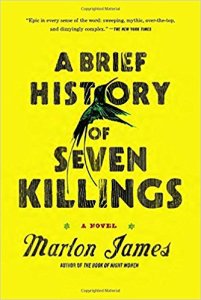
It’s an interesting feeling; finishing a book that you’re completely engrossed in. Especially when the story is so captivating. A Brief History of Seven Killings by Marlon James was the most challenging novel I have read in a while. With dozens of characters and a complex story, it took all my concentration to keep up without referring back to previous chapters. Often in books, when things get a bit dry, I tend to skim over the sections. You can’t do that with this book, or you’ll miss some key information. The author was nice enough to list the names of all the characters at the beginning of the book along with their occupation/credentials, as a sort of index to refer back to, to remind you who they are. However, to make things harder, since most characters are Jamaican, they also speak in Jamaican Patois with grammar very unlike English. For example, “I am” is almost always replaced by “me is”. Once you’re acclimated to that though, reading normal English starts feeling weirder. After getting used to the dialect, my reading increased in speed and I was actually able to focus more on the story than struggle with the sentence structures. After that, I was spellbound by the book.
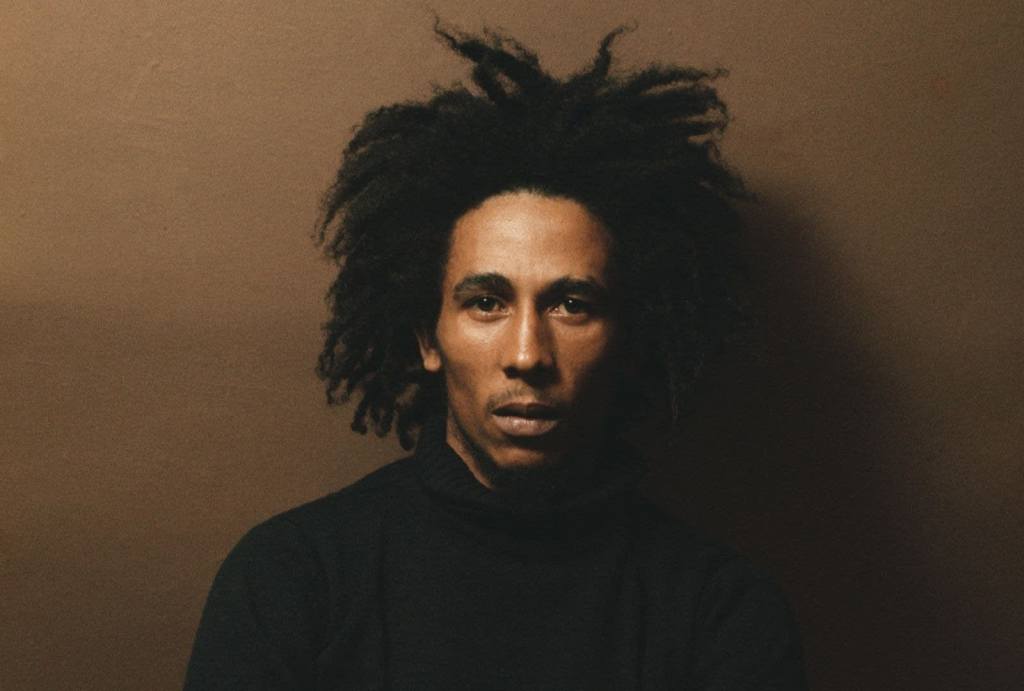
The story revolves around Josey Wales and his rise to power as the don of Copenhagen City in Kingston, Jamaica and the leader of the Storme Posse in New York. (I later found out that Wales actually had a real-life counterpart, a gangster named Lester Coke). The book also talks about the efforts of a Jamaican reggae superstar to promote peace between the two major political parties in Jamaica (clearly talking about Bob Marley, but always referring to him as “The Singer”). The political unrest had led to constant gang wars, high crime rate, and many unintended victims. With his peace concert, Bob Marley wanted to take a step towards ending that. A big topic in the book, however, is what happened two days before the peace concert, when unknown gunmen entered Marley’s home and shot him. While their identities are unknown in real life, in the book the shooting was arranged and executed by Wales himself. While my focus here is going to be the story in the book, for anyone interested, there is this excellent medium article that compares the book with actual Jamaican history.
The opening chapter sets the tone of the rest of the book quite well, where we hear from a fourteen-year-old boy named Bam-Bam as he witnesses some gang-members kill his parents and then joins the rival gang the same night. This makes it clear to the reader that there is no sugar-coating, and the book will get quite dark at some places. Although the main plot revolves around Wales and the Singer, there are many subplots interwoven throughout the book describing the lives of those affected by him from his own gang-members to journalists and CIA agents. We have Papa-Lo, the original gang leader in Copenhagen city who is now talking about peace when he accidentally kills a schoolboy. Wales later gets him killed to take his spot. Though we don’t hear from him directly, another character is Shotta Sheriff, the rival gang leader. There’s Alex Pierce, a journalist from the Rolling Stone looking for a big story who ends up finding out that Wales was the one who shot the Singer. Funnily enough, there is also the ghost of a murdered politician, Sir Arthur Jennings, who is usually there at the end of a section to reflect on recent events and talk about someone that recently died. And of course Wales’s gang: the crack-addict but well-read Weeper, the deadly Tony Pavarotti, the kids he recruits from the streets like Bam-Bam. There are many others, but these are the ones that stood out to me. One of my favourite characters is Nina Burgess. She represents someone who desperately wants to escape the country. But, she inevitably becomes part of Wales-Singer story when she bumps into him after the shooting of the Singer. She also had a one-night stand with the Singer, causing her to fall for the Singer. She eventually does manage to escape to America but feels that Jamaica is constantly following her around, from news articles (which she tries not to read), Jamaican fast food (which she tries not to eat), and Jamaican people (whom she tries to avoid). In midst of her escape, she takes on many identities throughout the book. And this is what I loved most about the book. There are no direct implications that the four characters narrating are actually the same person, other than minor clues. However, even without those clues, I was able to tell it’s the same person just by the tone and the way of expressing their thoughts. I think James did a wonderful job in maintaining that.
Another thing James put forward that I never thought about before was Bob Marley’s role in the politics of Jamaica. Till now, I’ve only seen Marley on college dorm posters about marijuana. I’ve never even heard his music. However, while we never actually hear him speak, he is a major character in the book, who, even after his death in ’81 was relevant to the story and someone the characters talked about constantly. We hear a lot about his philanthropy, his views on politics and religion and his influence on the politicians.
But overall, I think James’ biggest achievement with this book was how immersed you got into the character narrating a chapter. There are two moments, both with Bam-Bam, where it felt like I was in the situations he was in. One was his first time on cocaine. While reading about his mind racing and jumping between random thoughts, it was clear he is high off his mind. The entire train of thoughts was essentially a three-page long run on sentence which was constructed in a way that made me read it just as fast as Bam-Bam was thinking them. I could feel how his mind was working while on cocaine. The other was when Bam-Bam and another guy named Demus were being buried alive (told you it can get dark). This was by far the most intense chapter of the book. And looking back at it, I’m shocked it’s only three pages long. Bam-Bam and Demus took part in the shooting of the Singer and Wales wanted to dispose of them. The chapter is written through the eyes of Bam-Bam. His helplessness is obvious since he is bound and gagged. For a while, he could see his would-be murderers laughing as they throw dirt and rocks on him. But once the dirt made it over his head, just like the cocaine incident, his thoughts went all over the place. He begged God to give him superpowers, thought about his regrets of not moving forward with his woman, even thought of his parents and his childhood… I can barely write about it.
Finally, I just want to mention my favourite moment in the book, which was the only time I saw the cool and composed Josey Wales lose his temper and do something erratic. A crackhead (probably high at the time) decided it would be hilarious to shoot a water pistol full of urine on Wales’ face. Wales did not react immediately and let the crackhead run into the crack den. When his henchmen arrived, he simply asked them for their guns. Then like a gangster in a movie slowly walked towards the den and then proceeded to kill every single man in there. Till now, he had been like Michael Corleone from the Godfather II; everyone knew he was the don of dons, but there were no court cases or evidence against him. Even when he killed a man in front of a police station, no witnesses came forward. But this changed everything. He was now in public eye and got him sent to prison. And in the end, that is what led to his downfall.

 Kavi Reads
Leave a reply to Trapped in Virtual Reality – Kavish Cancel reply