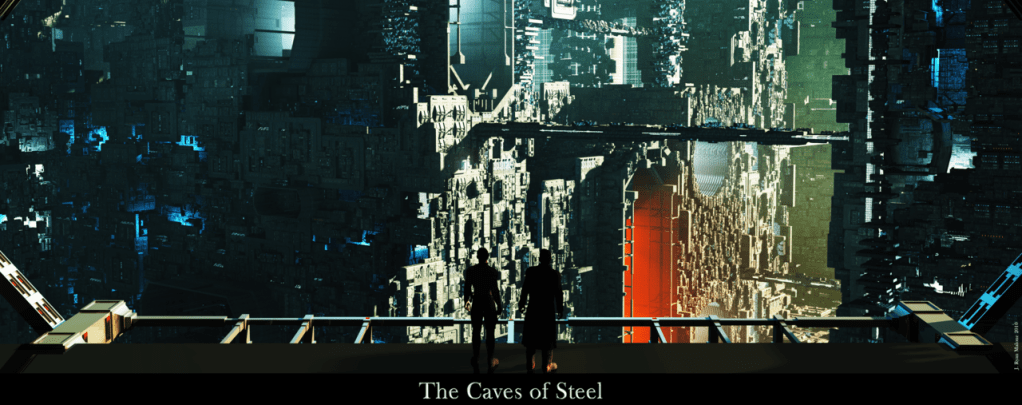
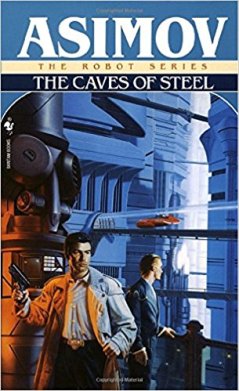
 In the midst of reading books such as Principles by Ray Dalio and When by Daniels Pink (incoming blog posts soon), I wanted to contrast the New York Times bestsellers about “how to be successful” with something more classic and less serious. So I decided to go with one of the most prominent names in science fiction: Isaac Asimov. It always surprises me when I think about how I’ve never read his books, given my fascination with robotics. Especially books like The Caves of Steel, which is also a whodunit story (my favourite genre in books). One of my friends from work and I decided to go down the Asimov path together, and this was the first book on the list.
There are not many books on my shelf that I started and completed within 48 hours. The last one I remember was And Then There Were None by Agatha Christie about six months ago. Usually, they tend to belong to the mystery/thriller genre and The Caves of Steel was no exception. After the steady success of Asimov’s short stories I, Robot, fellow science fiction writer and editor H. L. Gold suggested Asimov write a full novel concerning robotics. While he was initially hesitant to write a full novel based on robots, he ended up writing an entire trilogy. And it received every success it deserves. Overall, the book was phenomenal and, as I mentioned, very engaging. The characters, including the robots, are complex and relatable. It is a triumphant attempt to combine the detective and science fiction genres.
Spoiler-free
The story revolves around a detective on Earth, Elijah Baley solving a murder with a robot, Daneel Olivaw as his partner. A small twist here is that if the robot solves the case before the detective, the robot will end up replacing him in the police force. In this novel, humans have successfully conquered other worlds but the society was divided into two groups: the Earthers, living on the Earth and the Spacers, living on the Outer Worlds. Throughout the book, Asimov addresses the issue of technology, particularly robots, replacing humans, something which sparks many debates in today’s times as everyday robots are becoming closer to reality. This, of course, shows great foresight on Asimov’s part, who published the book in 1954. Spacers tended to be more pro-robot while Earthers despised them having been steadily replaced by robots. Earth is also suffering from overpopulation. The ‘caves of steel’ refer to the densely-populated, closed cities. There is no access to the sky or open grounds. Even food is produced in factories using yeast.
It’s always interesting reading a book written a long time ago about a future that is slowly approaching. One of the things that I thought were funny was how the conservative, strongly anti-robot people among the Earthers were called medievalists, a word we would obviously associate with the Middle Ages. In fact, times like the 21st century were even referred to as Medieval times. The other thing that amused me was Asimov’s idea of overpopulation on the Earth, which was eight billion people. That number may have seemed huge in the ’50s, but is very close to the population today. One thing that did impress me about the whole story was how Asimov avoided the robot turning into a Deus ex Machina. It would’ve been easy to get the protagonist out of any situation by letting the robot handle it in some obscure, plot-convenient way. But Asimov avoided that and let the story, and any technology used by the characters, be grounded in reality.
Spoilers ahead
One of my favourite plot points in the book was the conversion of our protagonist, Elijah Baley from a medievalist to a more pro-robot futurist. There was no sugar-coating that Earth was in deep trouble. Food was barely enough and the population was ever-increasing. Even the uranium deposits were depleting. And while they still had access to solar energy, any system they could build to sustain would be so fragile that a single part failing could result in millions dying of starvation. On the other hand, Spacers had their own problem of underpopulation (which was partly the reason they were in favour of living with robots). The Spacers knew the only way for humanity to really survive is if Earthers start colonising new worlds. However, Earthers shared a common distrust of Spacers and a hate for robots. This murder case was a way for Spacers to plant the idea of space travel in the Earthers’ minds. And they succeeded. Baley saw their view and even managed to convince a hardcore medievalist about it. In the end, since the murder itself was committed by a prominent leader among the medievalist, it became an easy way to plant the same idea into everyone’s minds. As someone who has always been pro-technology, it was nice to see the book end on a positive note with a nod towards a better future where robots and humans can live in harmony.


 Kavi Reads
Leave a reply to 2018 in Books (Part 1) – Kavish Cancel reply