
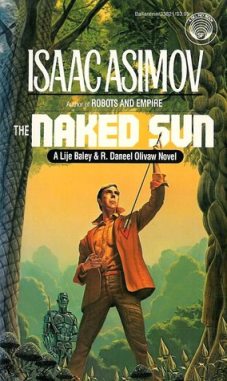
 After reading The Caves of Steel, I wasted no time before moving on to the next book in Asimov’s Robot Series: The Naked Sun. And similar to the first book, The Naked Sun had the elements that, together, made an excellent science fiction detective novel. This time, we have a murder on a planet far from Earth, where robots outnumber humans 10,000 to one and no crime has been committed for centuries. And to the rescue, we have our favourite duo from the first book: Earthman, Elijah Baley and his robot partner, R. Daneel Olivaw. Together, they have the task of solving the murder on a planet where people are so dependent on robots that they live in complete isolation and physical contact is taboo (other than what is required for children). Once again, Asimov delivers a masterpiece with well-developed characters, just the right amount of mystery and surprises and a glimpse into what society could end up as if we remain hopelessly dependent on technology. And, as if detectives, robots and outer space weren’t enough, Asimov completely won me over when he added a quote from Sherlock Holmes, “Once you eliminate the impossible, whatever remains, no matter how improbable, must be the truth.”
Spoiler-Free
The plot kicks in when Baley gets a special invitation from the planet of Solaria to go solve a murder of a prominent roboticist. Although surprised that the Spacers, who traditionally detested Earthmen, would be so desperate as to ask one to come to their planet and help them. On the way to Solaria, Baley is reunited with his partner, Daneel. With no witnesses to the murder, and no murder weapon found, their task was daunting enough, only made worse by the fact that since people simply don’t see each other in person, making it almost impossible for anyone to believe that the murder took place at all. The robots, on the other hand, are bound by the three laws, the first of which states that a robot cannot harm a human and therefore, out of suspicion (though that never stops Baley from distrusting them).
Asimov portrayed quite well what happens when two extreme societies collide. On one hand, we have Elijah Baley, the man who lives on Earth in overpopulated, permanently enclosed cities and has never been outside, seen the Sun, or felt the real wind. Any exposure to the outside world makes him instantly uncomfortable. On the other hand, we have the planet of Solaria, where the population is so low, every human has a city-sized estate. However, no one ever sees anyone else, other than through VR contact devices. Even the thought of someone physically present near them is repulsive. This, of course, brings Baley, who is used to cramped spaces constantly surrounded by people at odds with Solarians, who live in large open spaces and cannot stand anyone near them. There are multiple moments in the story where, as a reader, I felt almost irritated at how ridiculous the Solarians were compared to Baley. But those were always neatly balanced by Baley’s equally ridiculous phobia of sunlight or trees.
Spoilers ahead
I first heard about Asimov’s three laws when I was in high school. At the time, they seemed quite perfect; no loopholes could be seen. Even while reading The Caves of Steel and The Naked Sun, where they are mentioned constantly, it looked like there was no way to get around them. However, Baley found the loophole; one that seems quite obvious in hindsight. The first law states: “A robot may not injure a human being or, through inaction, allow a human being to come to harm“. Baley rephrased it: “A robot may not knowingly injure a human being or, through inaction, knowingly allow a human being to come to harm“. Simply adding that word means now the robot can harm a human if it doesn’t know about it. A simple example: if I ask robot one to mix an unknown, clear liquid into a glass of water saying I will drain it later, it would follow my order without question (second law). Then, if I ask robot two to serve that water to someone, they would also do it without question (since it doesn’t know there is something mixed in). And without much effort, I have made it so the two robots can poison a human. In fact, the prime roboticist on Solaria also realised this and made a plan to make robot-driven spaceships that would wage war on other planets and conquer them. Even though the robots are equipped with the first law, they would not hesitate to shoot and destroy enemy spaceships since they would simply assume the other spaceship also only has robots.
This has huge implications. Unlike Earth, the entire Spacer society is built based on the faultlessness of the three laws. Robots are an integral part of their everyday lives. Knowing that robots can technically harm humans can cause mass panic in other planets, and give Earth another reason to revolt against the rise of robots. Which is why Baley decides to keep it to himself. And the prime roboticist, who was the real murderer, killed himself and his plan to invade died with him. I would be curious to see if this loophole in the first law gets referenced again in the third book.



 Kavi Reads
Leave a reply to Foundation and Earth by Isaac Asimov – Kavish and Books Cancel reply