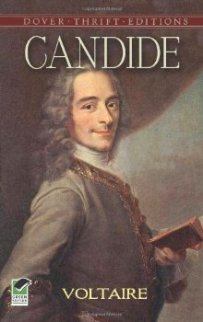
 I have been fascinated by Voltaire ever since I read Robert Massie’s biography of Catherine the Great (phenomenal book, by the way, for anyone interested) last year. Unfortunately, being a writer from the 18th century, his work was not as readily available in libraries and I never really put much effort into it. Earlier this week, while I was fishing for my next audiobook, I stumbled across a book called Candide and the author was none other than Voltaire. Thinking of this as the perfect opportunity to get introduced to the great philosopher, I immediately checked it out. And thanks to its shorter length, swiftly finished it too.
Candide (or Optimism) follows the adventures of a young, naive Pilgrim named Candide He grows up in German baron’s castle under the tutelage of philosopher Pangloss. Pangloss teaches Candide that “he is living in the best of all possible worlds“, a mindset that fuels Candide’s optimism and becomes his life’s guiding principle. This makes Candide Voltaire’s direct response to and, in a way, a mockery of Leibniz’s Philosophical Optimism. Voltaire uses the character Pangloss to satirize both Leibniz and his “best of all worlds” optimism. Candide falls in love with the baron’s daughter, Lady Cunégonde, for which he is banished from the castle. He is enlisted in the army where he witnesses horrifying battles and is flogged and almost killed for deserting when he decided to go on a walk. Best of all possible worlds? On leaving the army, he begins his journey across Europe and South America. On his way, he meets many people, like the kind anabaptist, who drowns in a storm saving a terrible sailor, and the old woman, whose own journey is littered with adversities from rape to cannibalism. Best of all possible worlds? Later he finds Pangloss again who has contracted syphilis and before we know it, Pangloss is hanged for being a heretic. Before tells Candide about the death of his love, Lady Cunégonde. He witnesses earthquakes with death tolls in tens of thousands, slavery, and other brutalities of the 1700s.Best of all possible worlds? Despite all this, Candide never loses faith in his mentor’s words and drives himself forward with optimism. He eventually reaches the utopian lands of El Dorado, where gold and jewels litter the ground. He leaves this place with more wealth than all the European Kings combined only to lose it all to a Dutch pirate. The book is full of such tales where Voltaire injects humour into the most serious situations and rains tragedy upon Candide just when things are looking up. Voltaire refutes the “Best of all possible worlds” theory over and over again showing that Leibniz’s benevolent world doesn’t exist. Even when Candide reaches the supposedly perfect world of El Dorado, it’s so boring that he can’t wait to leave. The novel ends not with an adventure or big twist, but with Candide and is friends gardening, simply keeping themselves occupied to make life bearable.
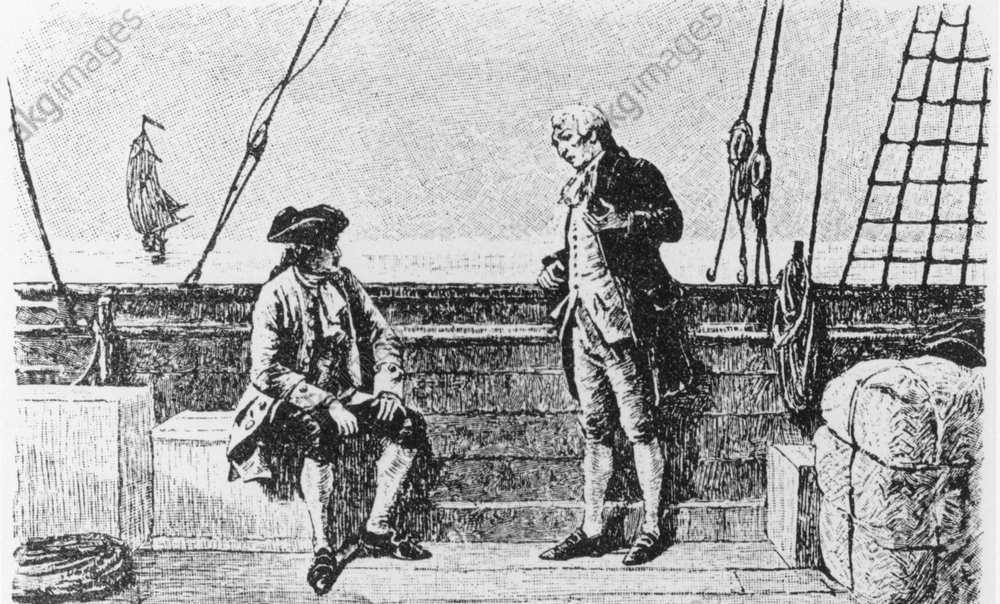
While the novel is entertaining throughout, my favourite parts were the conversations between our optimistic Candide and the pessimistic scholar, Martin. Like fire and water, there wasn’t a single point that the two agreed on. Any time Candide would bring up something positive in the world, he would immediately be shut down by Martin’s more realistic version. Of course, Candide never gave up.
Candide is a story that, while written in the 18th century, remains just as fresh today. It is a comment on the nature of humans, which remains the same no matter how far we come technologically. With the exception of the earthquake, most of the suffering in the book is not inflicted by a higher power but by humans on each other. Candide almost behaves as a report on the state of the world in the form of a philosophical cartoon strip. This is emphasised by the novel’s satirical theme. Voltaire did not intend the actual storyline to be realistic or even coherent at times, with constant reversals in fortunes, characters being left for dead only to be revived in a few pages, the plot is driven forward by coincidences more than anything. In the end, Candide teaches us that while this may not be the best of all possible worlds, to live a fulfilling life, we must all continue to cultivate our garden. Nobody is going to do it for us.


 Kavi Reads
Leave a reply to 2018 in Books (Part 2) – Kavish and Books Cancel reply