
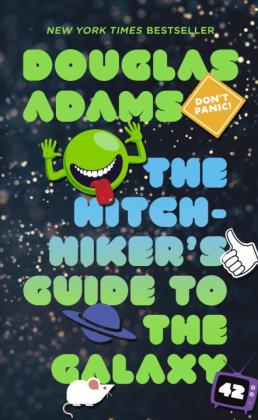
 What did I just read? How on Earth… wait, I shouldn’t say Earth because Earth was destroyed in the first few pages. How in the universe did Douglas Adams combine so much nonsense, dry humour, and science gibberish and turn it into such a masterpiece? Dare I call it genius? Or crazy? What else could come up with a sentence like “there’s an infinite number of monkeys outside who want to talk to us about this script for Hamlet they’ve worked out.”, or a name like “Slartibartfast”? All I know is that if I was alone in the universe with five books, I know one book that I will definitely be carrying. A science fiction classic and allegedly Elon Musk’s favourite book, The Hitchhiker’s Guide to the Galaxy packed more punch than all three Asimov books I read earlier this year. Mind you, I’m not saying those aren’t incredible in their own ways, but Douglas Adams embedded so much into a small and thin book, it truly felt like I was touring the universe and he was the guide.
The Hitchhiker’s Guide is a story of two beings: Arthur Dent, a human from Earth and Ford Prefect, a human-like alien from a planet of the star Betelgeuse who got stranded on Earth. It starts with Arthur trying to stop some workers from demolishing his home. When Arthur protested, the workers said that the plans for demolishing his house have been available in the local planning office for months. The blame went on Arthur for not dreaming about those plans and checking them out. Suddenly, Ford comes up and drags him to a bar to have exactly five beers and tells him an alien race called the Vogons are coming to destroy the Earth in twelve minutes. Right enough, a fleet of Vogon spaceships came and covered the sky announcing that the Earth is about to be demolished. When the people of Earth protested, the Vogons said that the plans for demolishing Earth have been available in the local planning department at Alpha Centauri for months. The blame went on Earth for not dreaming about those plans or having the ability to travel in space and checking them out. Both, Arthur’s house and Earth were promptly destroyed. Irony is spectacular.
Luckily, two escape by hitching a lift on one of the Vogons’ ships. Unfortunately, they were promptly thrown into space after being tortured by Vogon poetry. And luckily, they were saved literally a second before they would’ve died of suffocation. This begins their space adventures. On their way, they meet many different characters that Adams created. There was Zaphod Beeblebrox, the two-headed President of the Galaxy who became dedicated his whole life to becoming the president simply to steal a spaceship that only the president has access to. The clinically depressed robot Marvin, who obeyed every order with contempt and despair. Frankie and Benjy Mouse, two of the mice that were the true rulers of the Earth, experimenting on humans by pretending to be common lab mice. And so many more. Adams also goes through great lengths to describe how the technology in his universe works – such as the telepathic Babel Fish which can translate all known languages, and the Infinite Improbability Drive, an improbable way to travel faster than light. The explanations are clearly absolutely guff, but he casually throws things like Einstein’s Brownian Motion theory in there, as if explaining a real scientific concept.

I also found the origin of 42. When Arthur and Ford reach the allegedly legendary planet of Magrathea, they learn about Deep Thought, a brilliant supercomputer that was created to answer the question “What is the meaning of Life, the Universe and Everything?” It took 7.5 million years to get to the answer. The answer was… 42. After 7.5 million years of computation, 42. Deep Thought told the Magratheans that now they have the answer, they need to ask the right Question to learn its true meaning.
I was amazed at how similar Adams’s Guide was to Voltaire’s Candide, a book that I just happened to real last week. Similar to Arthur, Candide also went on a similar journey after his world was destroyed (metaphorically, in Candide’s case), learning more about the world around him, meeting new, interesting people and in the end, finding the answer to life. Where Candide teaches us that to live a fulfilling life, we must all continue to cultivate our garden and take care of ourselves and the people we care about, Guide teaches us that we can better understand the universe if we can better know what questions to ask. You know, other than how the English language could be made to defy all rules while still making hilarious sense.



 Kavi Reads
Leave a reply to Lilyn G Cancel reply