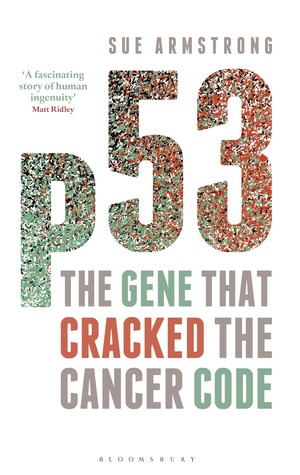
Usually, when I pick up a popular science book, it’s about a physics or maths topic. Not only because those are incredibly interesting subjects, but also because I have a decent foundation in both, so following along is a bit easier for me. In fact, in most, I often find a lot of things that I already know. However, this time I decided to step out of my comfort zone and go for a book on a topic that I haven’t studied since 10th grade. Despite having parents who are doctors, biology was never my forte. And though my mother is a pathologist specialising in cancer detection, the precious little I know about cancer is actually from a book I read almost two years ago (The Emperor of All Maladies by Siddhartha Mukherjee). I know certain cancer buzzwords from my childhood, like carcinoma, sarcoma, malignancy, but never really knew what any of those mean. Long story short, reading a book about cancer meant I am in completely uncharted waters. In case you haven’t guessed it, Sue Armstrong’s p53 is a book about cancer.
To get some technical terms out of the way, p53 is a gene. More specifically, it is a tumour suppressor gene. It regulates the cell cycle in the body and therefore is critical for cancer suppression. The name is due to its molecular mass: it is in the 53 kilodalton fraction of cell proteins. One of its discoverers, the oncologist David Lane, dubbed it the “Guardian of the Genome.” Sue Armstrong’s book, p53 is the story of the discovery, function, mutations of the gene and what really happens when our cells turn cancerous. More than that, it is a story of human ingenuity and how the quest for scientific understanding and years of research and hard work by various scientists led to thrilling breakthroughs in medical science, bringing us closer to unravelling one of the biggest enigmas in modern medicine.
Armstrong’s book was one of the best accounts I have ever read of how science is actually done. What happens when a researcher comes across data that doesn’t match the current beliefs and theories, or when a PhD student finds something her professor thinks is irrelevant, or when a scientist is refused funding and has to use his own money for research until he reaches a breakthrough. More than that, Armstrong’s book shows how are discoveries really made. Science textbooks are full of names of pioneers and their amazing discoveries. But, how did they get there? Here’s the general rundown: something unexpected and odd turns up; investigation begins; its character gradually becomes clearer but its purpose remains a mystery; then evidence accumulates to suggest a function. And sometimes further experiments show how wrong everything prior to then has been. In the case of p53, it was initially dismissed as an unimportant molecule. Then, for decades scientists thought it was an oncogene, i.e., a cancer-causing gene. But later, it was found to be the exact opposite; a tumour suppressor. Only when things go really wrong do p53 mutants start encouraging cancerous behaviour in cells.
Armstrong also shared the story of how p53 played a role in conclusively proving that smoking caused cancer, ending a decades-long debate and battle between Big Tobacco and scientists. It is something Siddhartha Mukherjee also focussed on a lot in his book. And it is one of my favourite stories since it’s a nice victory for science over large, profit-hungry corporations.
While we may wonder why so many people get cancer, many researchers are thinking the exact opposite: why so few? As cells die, living cells are constantly making copies of themselves and filling in the gaps. Every time a cell divides into two copies of itself, there is a change a mutation might occur. In fact, this mutation is what drives evolution. It only takes one rogue cell to be mutated a certain way that it goes on dividing indefinitely and forming a tumour. Given the number of cell divisions that occur in the body, there has to be a protection system or mechanism at work that specifically stops this from happening. That mechanism is p53. With so many different flavours of cancer, p53 stands as the common element in all of them. For most kinds of cancer to develop, p53’s suppressor activity has to have been disabled. Having a unifying factor between the different kinds of cancer means it might just be possible to have a unifying solution to it. Similar to how antibiotics work on any bacterial infection, we might just be able to develop a common, novel treatment for cancer. While the book provides ample hope for this, it also shows how frustratingly slow the process is from initial discovery to the marketplace. Nevertheless, p53 has already played a major role in our understanding of cancer, and will doubtless play an equally major one in finding the cure.
Thank you to David Lane, Arnie Levine, Michael Kress and Lloyd Old for the discovery of p53 and countless others who have contributed over the decades to bring us closer to the cure.
PS: I had to read the book twice to completely understand it. While it is one of the most compelling stories, it is also a bit technical. So I gave it a quick read first and then went back and read it properly. Totally worth it.



 Kavi Reads
Leave a comment