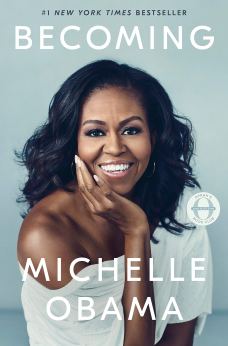
 With over two hundred people in line for the physical copy and almost five hundred for the audiobook, I thought it’d be months before I can get this overwhelmingly popular book from my library. So it was a lovely surprise when just within two months of getting in line, I got an email from my library that I could pick it up. And to make things better, it happened right before black history month ended.
There are some great books that you just have to read in one sitting. But then there are others you like to savour and spend time on. Becoming by Michelle Obama is one such book. I’ve read plenty of biographies of notable personalities from history. Whether it was Apple CEO Steve Jobs, Russian monarch Catherine the Great or Tennis star Rafael Nadal, the biographies go through a similar trajectory: we start with their childhood, some early sign of greatness, subsequent rise to power and finally their reign sometimes followed by a minor conclusion of life after they step down. Compared to that, Michelle Obama provides a much fresher look towards leadership and inspiration. She did not have the central role of leadership; that was her husband, Barack. But in many ways, she did play a necessary part. This book is a relatable, honest and fun account of how a little girl from South-Side Chicago went on, despite her scepticism and disdain of politics, to become the First Lady of the United States and continues to inspire millions to this day. Along with that, it is also a love story of two polar opposites, constantly adjusting with each other, but never forgetting the love they share.
She was born Michelle LaVaughn Robinson, in January 1964, during the term of Lady Bird Johnson. Her family lived on the second floor of a brick bungalow owned by a prim great-aunt and her fastidious husband. Her father worked in the city and her mother stayed at home taking care of her and her brother, Craig. Like many Americans, Michelle’s parents made do with what they had and poured their energy and money into their children. “We were their investment, me and Craig,” she writes. “Everything went into us.” A marked sense of preparedness and details, a strong work ethic and her gregariousness came directly from growing up in her family.
The idea of race had impressed on her early on. Both her father’s and mother’s families had fled the Jim Crow South for Chicago decades before, during the Great Migration of African-Americans out of the South to the North and West. Both her grandfathers had stories of when many unions and well-paying jobs excluded African-Americans. She is a descendant of the very caste of people that some of the previous first ladies had owned. She also bore witness to her neighbourhood slowly turn from what South-Side Chicago is today. She watched as moving vans showed up at the houses of one neighbour after another, peeling off the white residents along with the better-off black ones for the suburbs. At Princeton, unlike anytime before in her life, she was in the minority. She grew accustomed to being the only person of colour, “poppy seeds in a bowl of rice” she called it — as well as a young woman surrounded by confident men. When campaigning for her husband, she faced a very different form of criticism, with many commentators who weaponised her blackness against her. “The rumours and slanted commentary always carried less than subtle messaging about race, meant to stir up the deepest and ugliest kind of fear within the voting public. Don’t let the black folks take over,” she writes.
The role of “First Lady” is already a controversial one. It’s a blatant and explicit example of the patriarchal system since it’s entirely dependent on the man she is married to, with her only expectation being to make her husband look good. But she was never truly defined only by her role as First Lady. Well before she even met Barack, she was a well-established, Princeton-educated lawyer, later becoming an executive director at a nonprofit focused on training and mentoring young people for public service. Even when she became First Lady, we barely hear from then-President Obama. His achievements are simply mentioned as events happening in the background. A lot more time is spent on the issues she tackled and the stands she took with her Let’s Move! and Reach Higher initiatives. Even when talking about her husband, the focus from her was never lost. The role she played, the experiences she had and the struggles she faced were always the centre of the book.
Becoming is refined, gracefully-written and at times laugh-out-loud funny, with a humbler tone than might be expected of one who is on chatting terms with the queen of England. Michelle writes in the moment. None of the events is remembered with the hindsight of a celebrity or the knowledge of eventual success, but with the uncertainty and anxiety she felt at the time. Even with Barack’s wins in Senate race, Iowa caucuses and 2008 presidency, her tone is that of wonderment as to how this all happened. Her story was very relatable, from her disagreements with Barack leading to marriage counselling, to be being a working mother, constantly worried about her children, to anxiety over public speaking or a new job. From Aunt Robbie’s piano lessons to navigating “the quiet, cruel nuances of not belonging” at Princeton, to campaigning for Barack, to becoming the first black FLOTUS, a recurring theme in the book is the imposter syndrome she faced and quickly overcame. “Am I good enough?” is a question she invariably asked herself, and the answer was always “Yes I am.”

 Kavi Reads
Leave a comment