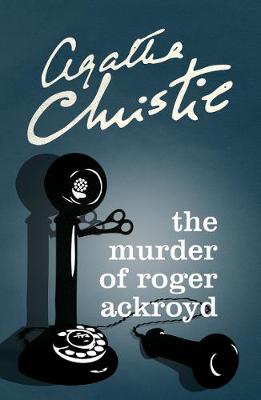
 Another book to continue on my Agatha Christie run, The Murder of Roger Ackroyd is one of her classics. In fact, so far, it might just be my favourite detective story. And that wasn’t an easy decision. It has a lot of rivals, from Sir Arthur Conan Doyle’s Sherlock Holmes, whom I practically idolize, to her own books I’ve read in the past. But somehow, this book stands out. And what’s amazing is, there isn’t one particular moment that makes it stand out, but a combination of many things. From Poirot’s personality to his investigation to that incredible ending, everything about that book was enjoyable.
No Spoilers
The premise of the book starts with the death of Mrs Ferrars, who was long rumoured to have poisoned her abusive, alcoholic husband. This news devastates Roger Ackroyd, a widower and a fellow victim of an alcoholic spouse, who was to marry Mrs Ferrars. Distraught, he invites his long-time friend Dr James Sheppard (who is also the narrator of the story) and some others to his mansion in Fenly Park. He shares with Dr Sheppard the possibility that Mrs Ferrars was being blackmailed by someone who knew she poisoned her husband and guilted her into committing suicide. He talks to Sheppard until about 9:30 after which the latter leaves. An hour later, Dr Sheppard gets a phone call that Roger Ackroyd has been murdered.
The doctor arrives on the scene with a few of Ackroyd’s friends who were staying at Fenly park. The police arrived shortly to open their investigation and name their primary suspect Ralph Paton, the man who was to marry Flora Ackroyd, Roger’s daughter and often had trouble with her father and is now missing. However, Flora is convinced of his innocence and asks Dr Sheppard for help and tells him about his neighbour, a famous Hercule Poirot. And thus Poirot enters the scene.
Something I always appreciated with the Poirot stories is how respected he is by all. There are instances when he says something too far-fetched and his age is brought up. However, for the most part, he is always seen as the retired police officer who did wonderful things in his time. This is quite a contrast to Sherlock, who, while respected, was also despised by most of the police because of his cold personality and a knack of proving everyone wrong. That said, Poirot has his own quirks. He is very confident in his own abilities and no afraid to accuse people when he thinks they are hiding something. Poirot’s personality is a delight and easily my favourite part of Christie’s novels based on him.
And I will say, when the murderer is revealed, you will be stunned. When the murderer will unravel the actions in front of you but you still won’t be able to get past the trauma of knowing the truth. The way Poirot picks up the cues is insane and even after divulging the truth to the murderer, Poirot’s action will keep you baffled.
The novel also had one of the greatest quotes I’ve ever heard
Never worry about what you say to a man. They’re so conceited that they never believe you mean it if it’s unflattering.
– Agatha Christie (The Murder of Roger Ackroyd)
Spoilers Ahead (i.e the ending)
That ending… I didn’t see that coming from a mile away. On one hand, it totally makes sense, since as we were approaching the final chapters, I still had no idea who the killer was. But on the other hand, I would never have suspected the doctor. Not only was he the narrator, but he was also Poirot’s sidekick.
In the modern series, Sherlock, there is often a running theme that someday, the killer would end up being the psychopath, Sherlock Holmes himself. However, no one would even dream of suspecting Dr Watson. This was Christie’s brilliance that has made this the best standalone detective novel I have read so far. It was awesome.




 Kavi Reads
Leave a reply to kavish Cancel reply